

Eternal Memorial Cards© since 1991
Elegant Memorial Cards | Crafted & Printed In Ireland . Guidance first published Oct 14, 2014 .Updated 2026
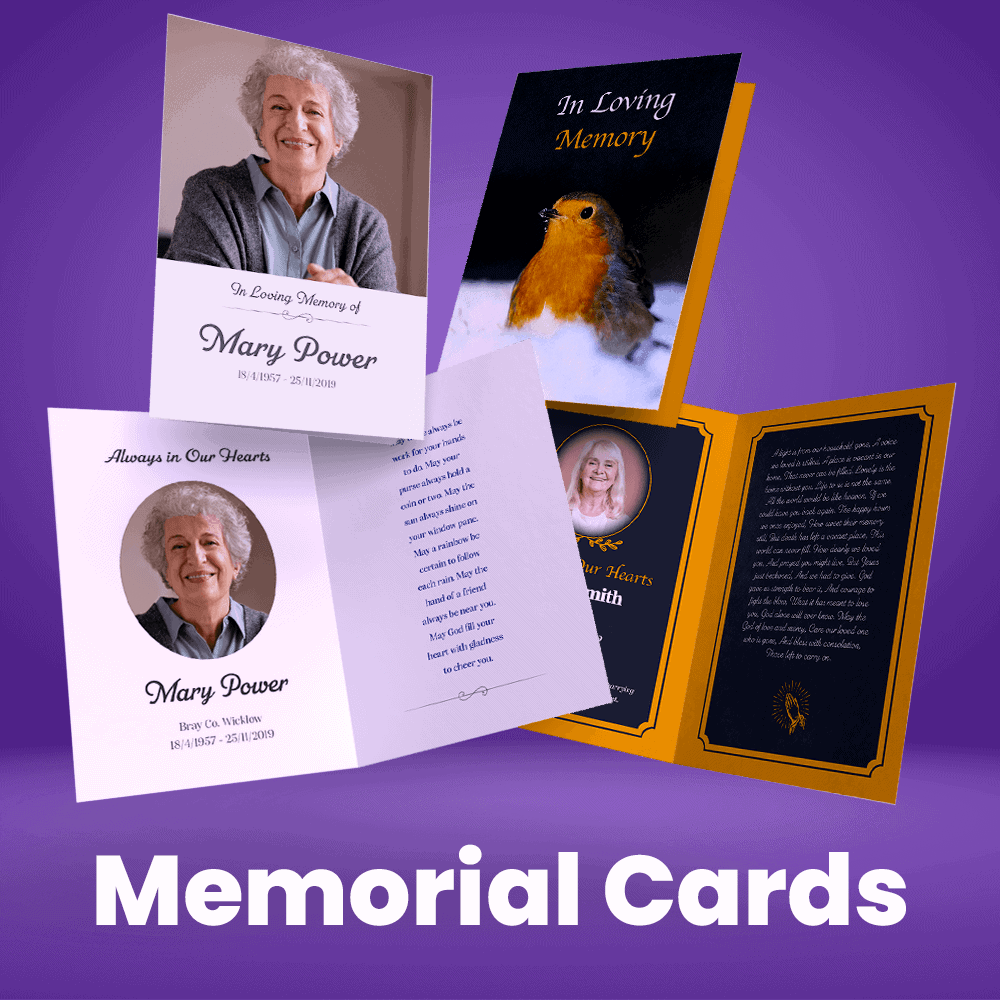
A Family Guide to Preparing Memorial Cards
Organising memorial cards is usually something families do at their own pace. There is no standard formula and no requirement to make every decision immediately.
Some families know exactly what photographs and wording they want to use. Others begin with very little decided and work through the choices gradually.
This guide explains some of the practical things worth considering when preparing a memorial card.
Begin With What You Already Have
You do not need to have the complete card planned before you start.
A good starting point is simply to gather whatever material is available, such as:
The person’s name and dates
One or more photographs
A prayer or verse if you would like one
Any personal wording you want included
Details of the person’s home town or family if appropriate
Once these are gathered, it becomes much easier to decide how the finished card should look.
Choosing the Main Photograph
The photograph on a memorial card is often the element that makes it feel most personal.
Rather than looking for a particular type of photograph, choose one that reminds you of the person as you remember them.
It may be a photograph taken at a family occasion, at home, on holidays or simply an everyday photograph that captures their expression particularly well.
Do not worry initially about whether the background is perfect or whether the photograph was professionally taken. We can look at the image first and advise whether it is suitable for the finished size.
Where possible, send the original digital photograph rather than a screenshot or a photograph copied several times through messaging apps, as the original file normally contains more detail.
Using Several Photographs
Some families prefer to use more than one photograph.
This can work particularly well when the pictures represent different periods of the person’s life or show interests, family occasions and places that were important to them.
There is no need to use every photograph you have.
A smaller selection of photographs that work well together will often produce a stronger design than trying to fit a large number onto one card.
If you are finding it difficult to choose, you can send us a selection and we can advise which images are likely to reproduce best.
Deciding How Much Information to Include
A memorial card does not need to contain a full biography.
Most families include the person’s name and date of death, with some also adding their date of birth, home town or address.
Other information is entirely optional.
You might include a favourite saying, a few words written by the family, a prayer, a poem or something that reflects the person’s character.
It is usually better to concentrate on information that has genuine meaning rather than filling every available space.
Religious and Non Religious Wording
Families have very different preferences when it comes to wording.
Traditional prayers and religious verses remain important to many people. Others prefer a poem, quotation or personal message without religious content.
You can also combine the two.
There is no particular format that a memorial card must follow. The wording should reflect the person being remembered and what feels appropriate to the family.
When Should Memorial Cards Be Arranged?
There is no compulsory date.
Some families begin arranging them relatively soon after the funeral, while others wait several months or until around an anniversary.
It is perfectly reasonable to leave the decision until the family feels ready.
Choosing photographs and wording can sometimes bring back strong memories, so there is little benefit in putting unnecessary pressure on yourself to have everything completed quickly.
How Many Memorial Cards Should You Order?
Before deciding on a quantity, make a simple list of the people and households you would like to receive one.
This can include relatives, friends, neighbours and people who knew the deceased through work, sport, clubs or the local community.
Remember that several people may live at the same address, so you may not need one card for every individual person.
It can be useful to order a few additional cards. Families sometimes remember somebody later or decide to keep spare cards for future family members.
Sending Memorial Cards
There are no formal rules governing who should receive a memorial card.
Families generally decide this themselves based on the relationships the person had during their life.
Some cards may be posted, while others may be given personally to relatives or friends.
The important thing is not to feel that every person who attended a funeral automatically has to receive one.
Preparing Names and Addresses
If a number of family members are helping, keeping one central list can make things easier.
A simple spreadsheet, notebook or document containing names and addresses can prevent duplicate cards being sent and makes it easier to calculate the quantity required.
Envelopes can then be addressed by hand or with printed labels depending on the family’s preference.
Check the Finished Design Carefully
Once the memorial card has been designed, take time to examine the proof before approving it.
In particular, check:
The spelling of the person’s name
Dates
Addresses
Photograph choices
Prayer or verse wording
Names of family members
Any personal wording
It is often useful to have another family member look at the proof as well.
At Eternal Memorial Cards, the design can be amended before printing if something needs to be changed.
Acknowledgement Cards
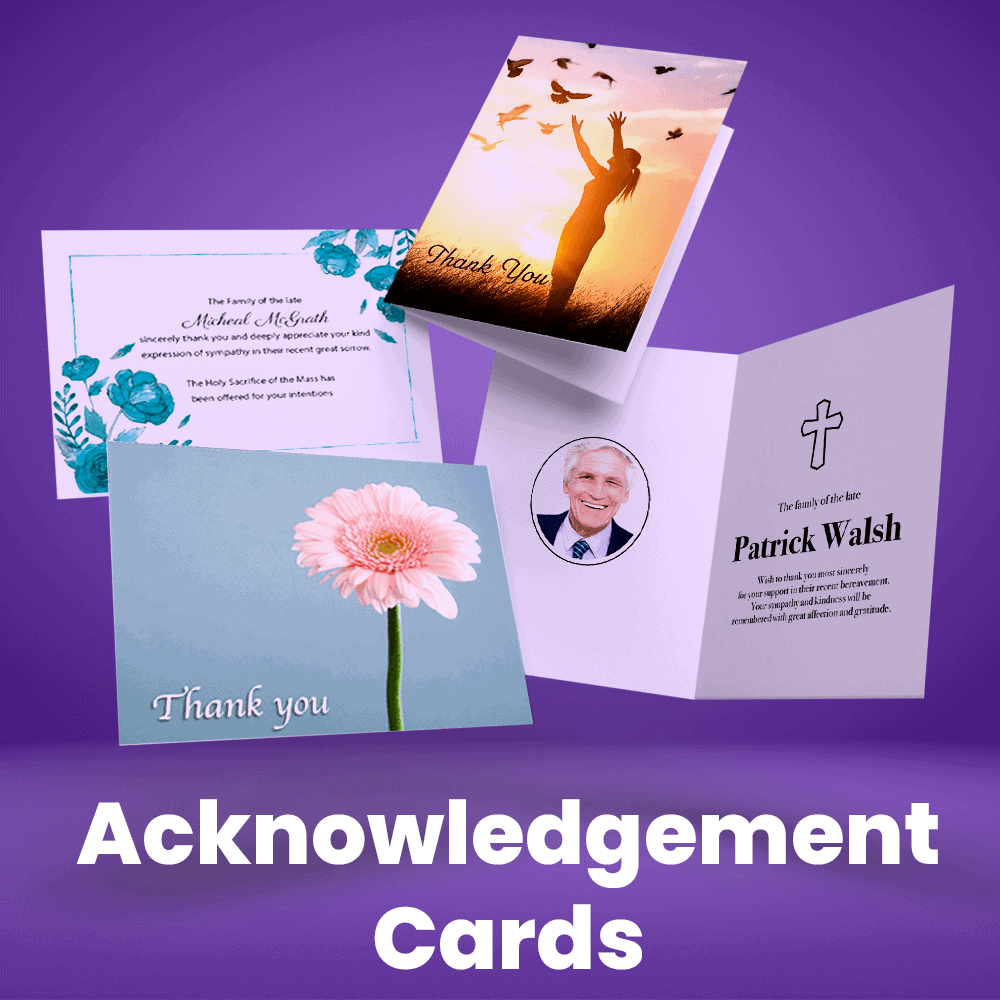
Acknowledgement Cards have a different purpose from Memorial Cards.
They are generally used by a family to thank people for kindness and support following a bereavement.
The wording can be very simple. Families might thank people for their sympathy, practical help, attendance at the funeral or support during a difficult period.
Acknowledgement Cards can be ordered separately from Memorial Cards and can be personalised with your own wording and photographs.
Making the Finished Card Your Own
The most important thing is that the memorial card feels appropriate for your family.
There is no requirement to follow a particular style.
Some families prefer a traditional card with a prayer and religious imagery. Others choose a modern design centred around photographs and personal wording.
By starting with the person rather than a fixed template, the finished card can become something meaningful that family and friends can keep.
If you need help choosing photographs, deciding how much information to include or selecting a suitable format, you can contact Eternal Memorial Cards before ordering.
If you have any inquiries, please don't hesitate to contact us at info@eternalmemorialcards.ie
If you have any inquiries, please don't hesitate to contact us at info@eternalmemorialcards.ie
GUIDELINES FOR SENDING FUNERAL THANK YOU CARDS / ACKNOWLEDGEMENT CARDS
Decide what you want the card to say
Before worrying about the design, think about what you would like the card to contain.
This might include:
Full name
Date of birth and date of death
Home town or address
One or more photographs
A favourite prayer
A poem or verse
Personal words written by the family
Religious symbols or images
A favourite saying
There is no requirement to include all of these.
A card with one strong photograph and a few carefully chosen words can work just as well as one containing several photographs and a longer verse.
Choosing photographs
Do not automatically reject a photograph because it was taken on a phone or because there are other people or unwanted objects in the background.
Send us the original photograph wherever possible and let us look at it first.
For the best result, avoid repeatedly saving or sending screenshots of the same photograph as this can reduce image quality.
If you have a printed photograph, photograph it carefully in good light from directly above or have it scanned.
Older family photographs can be particularly effective when combined with more recent photographs to show different stages of someone’s life.
When several family members are choosing photographs, it can help to select a small group of favourites first and then decide which ones work best together.
Think about who will receive the cards
There is no official list of people who must receive a memorial card.
Families commonly send them to relatives, friends, neighbours, work colleagues and people who knew the deceased through clubs, organisations or the local community.
A practical way of estimating your quantity is to make a recipient list before ordering and then allow some extras.
Extra cards are often useful later when the family remembers somebody who was accidentally left off the original list.
Check names and addresses early
Finding postal addresses can take longer than expected.
If several family members are helping, one person can keep a single list of names and addresses so that duplicates are avoided.
You can then address the envelopes by hand or prepare printed address labels.
It is also worth checking how many cards are going to the same household before deciding the final quantity required.
Check the proof carefully
The design proof is the stage at which everything should be checked.
Pay particular attention to:
Spelling of the person’s name
Dates
Names of family members
Prayer and verse wording
Photograph selection
Any addresses or other personal information
It can be useful to have another family member read the proof as well. A second person will sometimes notice a small mistake that everybody else has overlooked.
Nothing should be printed until you are satisfied with the final proof.
Acknowledgement Cards
Acknowledgement Cards, sometimes called Funeral Thank You Cards, are used by families to thank people for kindness and support following a bereavement.
They can be ordered separately or alongside Memorial Cards.
Who might you want to thank?
Think about the people who helped your family in a practical or personal way.
Depending on the circumstances this could include relatives and friends, neighbours, people who travelled to the funeral, members of clubs or organisations, carers, medical staff, clergy, musicians, funeral personnel and people who helped your family at home.
You do not have to create an enormous formal list. The family can decide who they particularly wish to acknowledge.
The message does not need to be complicated
A short sincere message is usually sufficient.
For example:
“Thank you for your kindness and support following our loss. It was greatly appreciated by all our family.”
Or:
“Our family would like to thank you sincerely for your kindness, sympathy and support during a very difficult time.”
If you want to write an individual message to certain people, space can be left on the card for handwriting.
Memorial Cards and Acknowledgement Cards serve different purposes
A Memorial Card primarily commemorates the person who has died and is intended as a lasting keepsake.
An Acknowledgement Card primarily allows the family to thank somebody for their support.
Some families send both. Others choose only one.
There is no right or wrong approach.
Need help with a photograph or wording?
If you have photographs but are unsure which ones will print well, or you are uncertain about how much wording will fit comfortably on a particular design, contact us before placing the order.
You can also browse our Memorial Cards, Wallet Cards, Bookmarks, Acknowledgement Cards, Lifetime Cards and Unique Luxury Memorial Card Range online.
Eternal Memorial Cards
51 Bracken Road
Sandyford
Dublin 18
D18 CV48
Telephone: 01 9081511
A Thank You Card / Acknowledgement Card is the family’s way of expressing gratitude to everyone who provided help and support before, during, and after the funeral. They can be sent to a wider circle of friends, acquaintances, or anyone who offered assistance. For example, neighbors, community members, medical professionals, nurses, carers, specific hospital wards, associations, charities you wish to acknowledge, the celebrant, musicians, and those who participated in the Mass, service, or celebration of life, as well as the funeral directors.Any mourners who may have travelled long distances to show their support during the funeral. Others may have made sandwiches brought gifts , made tea, organised parking or assisted after the bereavement in any way
When composing Thank You Cards / Acknowledgement Cards, you may want to include a personal thought or two about your deceased loved one that is appropriate for the recipient. Alternatively, you can keep your note simple by saying, “Thank you for your expression of kindness.” The message you include should depend on your relationship with the recipient. For co-workers or clients, a brief message might suffice, while for family and close friends, a more meaningful message would be appropriate
Think about who will receive the cards
There is no official list of people who must receive a memorial card.
Families commonly send them to relatives, friends, neighbours, work colleagues and people who knew the deceased through clubs, organisations or the local community.
A practical way of estimating your quantity is to make a recipient list before ordering and then allow some extras.
Extra cards are often useful later when the family remembers somebody who was accidentally left off the original list.
Check names and addresses early
Finding postal addresses can take longer than expected.
If several family members are helping, one person can keep a single list of names and addresses so that duplicates are avoided.
You can then address the envelopes by hand or prepare printed address labels.
It is also worth checking how many cards are going to the same household before deciding the final quantity required.
Check the proof carefully
The design proof is the stage at which everything should be checked.
Pay particular attention to:
Spelling of the person’s name
Dates
Names of family members
Prayer and verse wording
Photograph selection
Any addresses or other personal information
It can be useful to have another family member read the proof as well. A second person will sometimes notice a small mistake that everybody else has overlooked.
Nothing should be printed until you are satisfied with the final proof.
Acknowledgement Cards
Acknowledgement Cards, sometimes called Funeral Thank You Cards, are used by families to thank people for kindness and support following a bereavement.
They can be ordered separately or alongside Memorial Cards.
Who might you want to thank?
Think about the people who helped your family in a practical or personal way.
Depending on the circumstances this could include relatives and friends, neighbours, people who travelled to the funeral, members of clubs or organisations, carers, medical staff, clergy, musicians, funeral personnel and people who helped your family at home.
You do not have to create an enormous formal list. The family can decide who they particularly wish to acknowledge.
The message does not need to be complicated
A short sincere message is usually sufficient.
For example:
“Thank you for your kindness and support following our loss. It was greatly appreciated by all our family.”
Or:
“Our family would like to thank you sincerely for your kindness, sympathy and support during a very difficult time.”
If you want to write an individual message to certain people, space can be left on the card for handwriting.
Memorial Cards and Acknowledgement Cards serve different purposes
A Memorial Card primarily commemorates the person who has died and is intended as a lasting keepsake.
An Acknowledgement Card primarily allows the family to thank somebody for their support.
Some families send both. Others choose only one.
There is no right or wrong approach.
Need help with a photograph or wording?
If you have photographs but are unsure which ones will print well, or you are uncertain about how much wording will fit comfortably on a particular design, contact us before placing the order.
You can also browse our Memorial Cards, Wallet Cards, Bookmarks, Acknowledgement Cards, Lifetime Cards and Unique Luxury Memorial Card Range online.
Eternal Memorial Cards
51 Bracken Road
Sandyford
Dublin 18
D18 CV48
Telephone: 01 9081511
Acknowledgement Cards have a different purpose from Memorial Cards.
They are generally used by a family to thank people for kindness and support following a bereavement.
The wording can be very simple. Families might thank people for their sympathy, practical help, attendance at the funeral or support during a difficult period.
Acknowledgement Cards can be ordered separately from Memorial Cards and can be personalised with your own wording and photographs
At Eternal Memorial Cards, we help families in Navan create thoughtful memorial stationery from home, with a careful proof sent before printing.
Navan is a Meath county town and central service town for families across the county. Families here often have relatives, neighbours and friends spread through nearby places such as Kentstown, Johnstown, Wilkinstown, Athboy, Slane.
Orders from Navan can be placed online and delivered quickly with An Post tracked delivery once a proof is approved after printing.