Why send Memorial Cards
Why Send Memorial Cards?
Memorial cards have long been part of Irish bereavement tradition. For many families, they are a simple and meaningful way to remember someone who has died and to share that remembrance with relatives, friends and members of the wider community.
A memorial card can be kept for many years. It may sit inside a prayer book, a family album, a drawer of important keepsakes or simply somewhere close at hand. Long after the funeral has passed, it can remain as a small personal reminder of the person, their life and the memories associated with them.
A Lasting Keepsake
One of the main reasons families choose memorial cards is because they provide something tangible to keep.
A photograph, name, dates, prayer, poem or a few carefully chosen words can turn a small card into a very personal keepsake. For some people, receiving a memorial card gives them something they can return to whenever they wish to remember the person.
There are no strict rules about what a memorial card should contain. Some families prefer a traditional religious design, while others choose something simpler and more contemporary.
Remembering the Person Behind the Name
A good memorial card should feel connected to the person being remembered.
This can be achieved in many ways. A favourite photograph can immediately bring back memories. A particular prayer or verse may have special meaning. Some families include a short personal message, a favourite saying or words that reflect the character of the person who has died.
The aim is not to include as much information as possible. Often a carefully chosen photograph and a small amount of meaningful wording can create a stronger and more personal result.
Religious and Non Religious Memorial Cards
For many Irish families, faith remains an important part of remembrance. Memorial cards may include a traditional prayer, religious image, cross, saint or other symbol of faith.
Other families may prefer a design with little or no religious content. They might choose photographs, flowers, landscapes, personal wording or a favourite poem instead.
Both approaches are entirely appropriate. The card should reflect the wishes of the family and, where possible, the personality and beliefs of the person being remembered.
A Way to Share Memories With Others
Memorial cards are often sent to relatives, friends, neighbours, former work colleagues and people who knew the deceased through clubs, organisations or the local community.
For somebody who lived far away or was unable to attend the funeral, receiving a memorial card can be particularly meaningful.
There is no official list of people who should receive one. Each family can decide who they would like to include.
When Should Memorial Cards Be Sent?
There is no fixed date by which memorial cards must be sent.
Many families arrange them during the months following the funeral. Others wait until closer to the first anniversary, while some families choose to organise them much later.
It is worth taking the time needed to choose photographs and wording properly rather than feeling under pressure to have the cards completed by a particular date.
Choosing Photographs
Photographs are often the most important part of a memorial card.
You might choose a recent portrait, a favourite family photograph or an older image that brings back a particular memory. Some families use several photographs showing different stages of the person’s life.
Do not automatically dismiss a photograph because it was taken casually or on a mobile phone. Sometimes the photograph that best captures somebody’s personality is not the most formal one.
If you are unsure whether a photograph is suitable for printing, it can be checked before the design is completed.
Making the Card Personal
Personalisation does not have to mean complicated design.
You can make a memorial card distinctive through:
- A favourite photograph
- A meaningful prayer or verse
- Personal words written by the family
- A favourite saying
- A place that was important to the person
- Religious imagery where appropriate
- Several photographs showing different times in their life
The most important thing is that the finished card feels right for the family.
Proof Before Printing
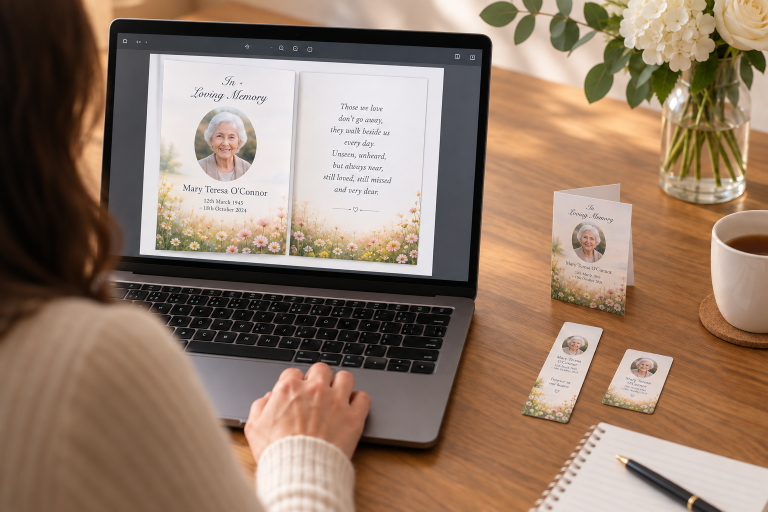
Families should have the opportunity to see the complete design before anything is printed.
At Eternal Memorial Cards, a proof is prepared using the photographs and wording supplied. The family can then check names, dates, photographs, spelling and layout and request changes if necessary.
Printing only takes place after the final design has been approved.
This is particularly important with memorial stationery, where even a small error in a name or date matters.
A Small Card With Lasting Meaning
Memorial cards are simple objects, but they can hold considerable personal meaning.
They offer families a way to remember a loved one, share that memory with others and create something that can be kept long after the funeral itself.
Whether the design is traditional, religious, modern or completely personal, the purpose remains the same: to create a respectful and lasting reminder of someone who was important.
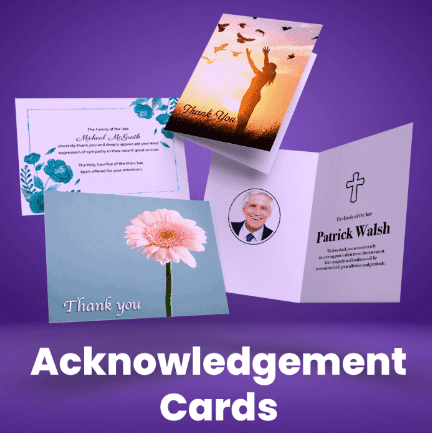
Eternal Memorial Cards offers a wide selection of Memorial Cards, Wallet Cards, Bookmarks, Acknowledgement Cards and Unique Luxury Memorial Cards, all of which can be personalised with your own photographs and wording.
You can browse the full range at Eternal Memorial Cards or contact us if you would like advice before ordering.